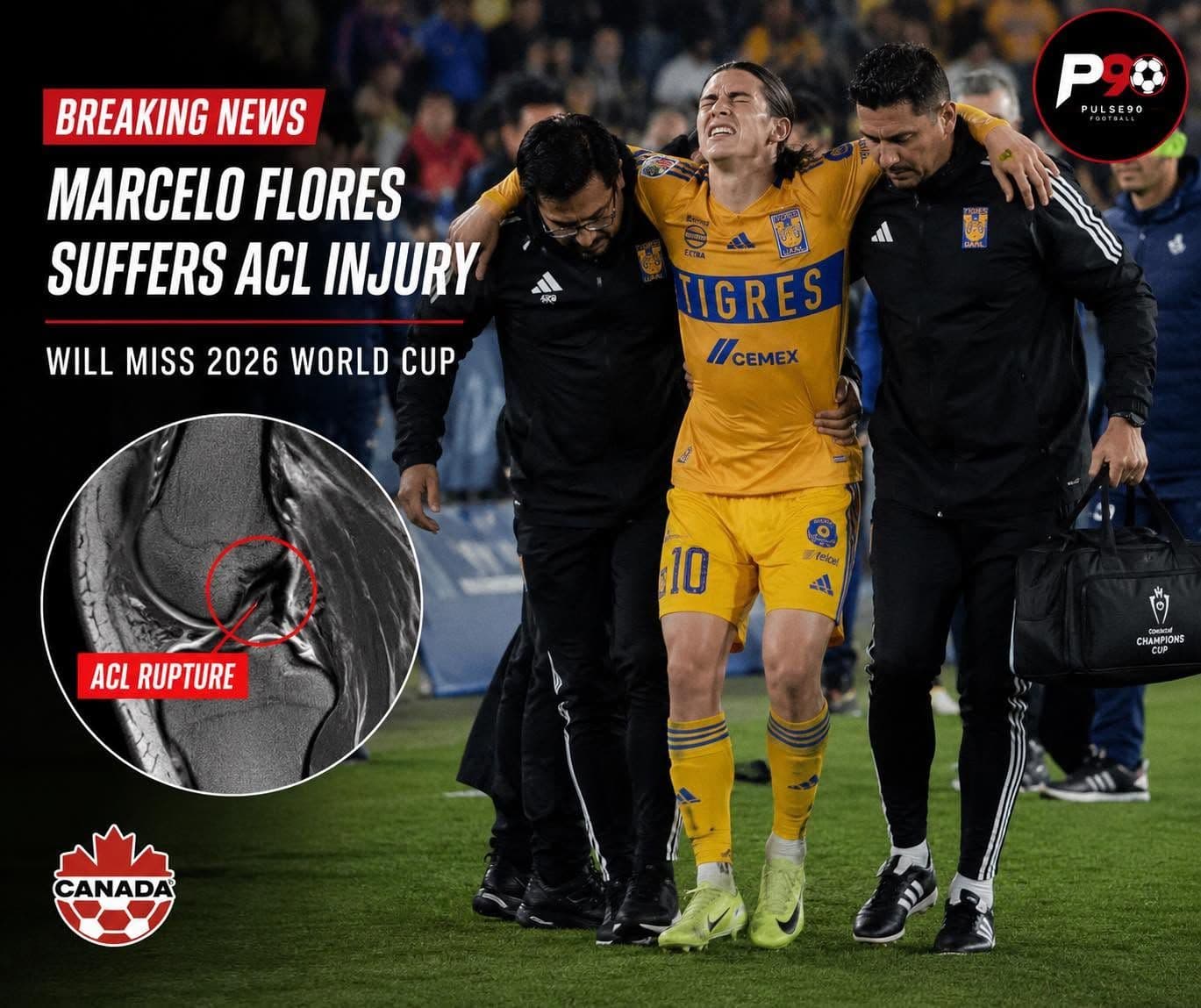
In a moment that sent shockwaves through Canadian soccer, midfielder Marcelo Flores suffered a severe ACL injury that will sideline him from the 2026 FIFA World Cup a tournament Canada was primed to compete in on home soil. Flores, one of Canada's most promising midfield talents, represents not just a loss to his national team, but a stark reminder of how quickly an ACL injury can derail an athlete's career, goals, and dreams. For Flores and his teammates, his absence is a painful reality that no amount of talent or preparation can overcome.
Marcelo Flores' injury is not an isolated incident. Across professional soccer globally, ACL injuries are claiming players at alarming rates devastating teams, cutting short careers, and raising critical questions about injury recovery, return-to-play protocols, and the biological limitations that even the world's greatest athletes cannot overcome. As the 2026 FIFA World Cup started featuring an unprecedented 48 teams competing across North America multiple star players will be absent from the pitch due to ACL tears, hamstring injuries, and other ligament damage.
At Pro-Motion Physiotherapy, we understand the profound impact of ACL injuries. Whether you're watching elite athletes like Marcelo Flores navigate their recovery journey or managing your own knee injury, this guide explores why ACL injuries are so common in soccer, what happens during recovery, and how structured physiotherapy not shortcuts determines successful return to play.
Soccer and the ACL: A Perfect Storm for Serious Injuries
Soccer is a fast-paced, dynamic sport where athleticism, precision, and split-second decisions create a high-risk environment for injury. Collisions, rapid directional changes, and explosive movements are inherent to the game and they come with a price.
Research consistently shows that soccer players experience some of the highest rates of lower body injuries, particularly around the ankle, knee, shoulder, and neck. Of all these injuries, the anterior cruciate ligament (ACL) injury stands out as one of the most devastating. In fact, soccer has the highest risk of ACL injury among all sports.
Here's the troubling part: despite widespread awareness and the implementation of injury prevention protocols, the rates of ACL tears in soccer have not decreased. Even elite athletes with access to world-class training facilities, injury prevention programs, and medical support continue to suffer these injuries. This underscores a fundamental reality, some ACL injuries, particularly non-contact tears that occur during sudden pivoting or deceleration, may be difficult to prevent entirely.
The Long-Term Cost of ACL Injury
While many players do recover from ACL injuries and return to competition, recovery comes with lasting consequences. Players who suffer ACL injuries experience higher rates of early-onset osteoarthritis premature wear and tear on the knee joint that can impact quality of life for decades. They also face a significantly higher risk of sustaining additional knee injuries, and in many cases, their playing careers are shortened.
This sobering reality is exactly why rehabilitation after ACL injury cannot be rushed or minimized. The stakes both for elite athletes and everyday people are far too high.
The 2026 World Cup: Who's Playing, Who's Not, and Why
The 2026 FIFA World Cup features unprecedented participation, 48 teams instead of the traditional 32, hosted across Canada, Mexico, and the United States. With so many players competing at the highest level, it's instructive to look at which star athletes will be present and which will be absent due to injury.
Players Expected to Return
A small number of elite players have targeted recovery timelines that align with the 2026 tournament. These include:
Kylian Mbappé (France) :- One of the world's most talented players
Lamine Yamal (Spain) :- A rising star with exceptional potential
Mohamed Salah (Egypt) :- A consistently world-class performer
Players Sidelined by ACL and Serious Injuries
Many more players will miss the tournament due to injuries that require recovery periods extending well beyond the World Cup. These include:
Marcelo Flores (Canada) — ACL Injury The Canadian midfielder's ACL injury represents a significant loss for Canada's World Cup aspirations. As one of the team's key players in midfield, Flores' absence will be felt deeply. An ACL injury of this severity typically requires 9–12 months of recovery and rehabilitation before an athlete can safely return to competitive soccer. For Flores, this means missing the 2026 tournament on home soil, a heartbreaking blow for both player and nation.
Rodrygo (Brazil) — ACL Rupture + Meniscus Tear Real Madrid forward Rodrygo had been managing a partial ACL tear since 2023, continuing to play despite the underlying damage. Following surgery in early March 2026, he was cleared to return to competition. However, just eight weeks post-surgery, far too soon; he returned to play in a critical Real Madrid vs. Getafe match. Within minutes, catastrophe struck: he ruptured his ACL completely while simultaneously tearing his meniscus. This double injury is a cautionary tale of returning to high-intensity competition before adequate healing. As of now, he is unlikely to play until well into 2027.
Éder Militão (Brazil) — Hamstring Injury The defensive cornerstone for Brazil's World Cup hopes faces a hamstring injury with a moderately long recovery window, making his participation uncertain.
Ben White (England) — Knee Ligament Injury England's reliable defender is dealing with a knee ligament injury classified as moderate-to-high severity. His recovery timeline is uncertain, and his availability for the tournament remains in question.
Joaquín Paníchelli (Argentina) — ACL Injury The Argentine player's ACL injury is classified as high severity, with a typical recovery timeline of 9–12 months. Depending on the injury's exact nature and his rehabilitation progress, he may or may not be available for World Cup selection.
Understanding ACL Injury Severity: Tears vs. Ruptures
A critical distinction exists between ACL tears and ACL ruptures - and it profoundly affects recovery and return to play timelines.
ACL Tears
An ACL tear refers to partial tearing of the ligament fibers. The ligament remains partially intact, preserving some structural integrity and function. There are three grades of ACL injuries:
Grade 1 (Mild Sprain): Ligament fibers are damaged, but the ACL remains in one piece. Pain and swelling are present, but stability may be minimally affected.
Grade 2 (Partial Tear): Ligament fibers are partially torn. The ACL is damaged but not completely separated. Significant pain, swelling, and some instability occur.
Grade 3 (Complete Tear/Rupture): This is the most severe, a complete break where the ligament is fully separated. The knee becomes severely unstable.
The good news: Grade 1 and 2 tears can sometimes be managed conservatively with rest and physiotherapy, avoiding surgery. However, Grade 3 ruptures (complete tears) almost always require surgical reconstruction.
ACL Ruptures
An ACL rupture is a complete break of the ligament, it is snapped in two. This is the most severe form of ACL injury and is analogous to a Grade 3 complete tear. A rupture requires surgical reconstruction using a graft (harvested from the patient's own tissue or from a donor). Surgery is not optional; it is necessary to restore knee stability and enable return to high-demand activities.
Players like Marcelo Flores and Rodrygo who suffer complete ruptures face an extended and demanding rehabilitation journey that cannot be rushed or compromised.
The Timeline to Recovery: What Athletes Must Understand
Recovery from ACL injury particularly ACL rupture requiring surgery, is a long, structured process. The standard recovery timeline is 9–12 months before return to competitive sports. This is not arbitrary; it reflects the biological healing process of the graft and the progressive demands of rehabilitation.
Typical Recovery Timelines for Common Soccer Injuries
Hamstring Injury: 4–12 weeks. This range reflects the severity of the tear and the demands of returning to high-speed running.
Meniscus Repair: 3–6 months. The meniscus is cartilage with limited blood supply; healing is slower than muscle.
ACL Reconstruction: 9–12 months. This is the standard timeline for surgical ACL reconstruction followed by comprehensive rehabilitation.
ACL + Meniscus Combined Injury: 12–18 months. When both structures are damaged—as happened with Rodrygo—recovery is extended significantly.
Why Athletes Return Too Early and Why They Shouldn't
There is mounting pressure both internal and external for injured athletes to return to play quickly. Team needs, financial incentives, personal drive, and major tournaments create urgency. Rodrygo's injury serves as a cautionary tale: returning to competition before the graft had adequately healed and before comprehensive rehabilitation was complete led to immediate re-injury.
Research shows a significantly higher risk of re-injury if athletes return before completing 9–12 months of rehabilitation. Re-injury often results in re-tearing the graft, damaging other structures (like the meniscus), or developing compensatory movement patterns that lead to chronic instability.
The biological timeline cannot be rushed. The ligament graft must undergo specific phases of healing and remodeling. The neuromuscular system must be retrained to provide dynamic stability. The athlete's confidence and psychological readiness must develop. Skipping these steps creates vulnerability and often ends careers prematurely.
The Critical Role of Physiotherapy in ACL Recovery
ACL surgery is just the beginning. The real determinant of successful recovery is the structured, progressive physiotherapy program that follows. Here's what comprehensive ACL rehabilitation must include:
Phases of Post-Operative Rehabilitation
Weeks 1–2 (Protection & Pain Management): Focus on protecting the surgical site, managing swelling, and initiating gentle range-of-motion work.
Weeks 3–6 (Early Motion & Activation): Gradual progression of movement, quad and hamstring activation, careful weight-bearing, and swelling reduction.
Weeks 7–12 (Intermediate Strengthening): Progressive resistance training, balance and proprioceptive work, and neuromuscular retraining.
Months 4–6 (Advanced Strengthening & Functional Training): Closed-chain exercises (foot planted), dynamic balance, and introduction of sport-specific movement patterns.
Months 7–12 (Return to Sport Training): Sport-specific drills, agility work, multi-directional movements, and controlled progression back to competitive play under supervision.
Key Components of Effective ACL Rehabilitation
Individualized assessment and programming tailored to the specific injury, patient goals, and sport demands
Progressive resistance training to restore muscle strength, particularly the quadriceps and hamstrings
Proprioceptive retraining to restore the body's ability to sense knee position and movement
Balance and stability work, including single-leg and dynamic balance exercises
Sport-specific training mimicking the demands of soccer: acceleration, deceleration, pivoting, and directional changes
Return to sport testing using objective measures (strength testing, hop tests, agility assessments) to verify readiness
Psychosocial support addressing fear of re-injury, confidence building, and mental resilience
Lessons from Marcelo Flores and Recent Injuries
Marcelo Flores and other injured players at the highest levels of professional soccer have access to resources most of us can only imagine: personal medical teams, advanced rehabilitation facilities, sports medicine specialists, unlimited access to physiotherapy, and financial security to take time off work. Yet even they cannot escape the biological timeline of healing. They cannot rush the process without facing catastrophic consequences.
This teaches us three critical lessons:
Recovery Cannot Be Rushed. No amount of motivation, talent, or resources can compress the biological timeline of healing. The ligament graft must undergo specific phases of remodeling and strengthening.
Returning Too Early Invites Catastrophe. Re-injury rates are significantly higher when athletes return before completing their rehabilitation. The consequences can end careers as Rodrygo's case demonstrates.
Physiotherapy Is Essential, Not Optional. Surgery stabilizes the knee, but physiotherapy restores function, strength, and confidence. Comprehensive rehabilitation is what determines successful return to sport.
How Pro-Motion Physiotherapy Can Guide Your ACL Recovery
Whether you're recovering from recent ACL surgery, managing a partial tear, or seeking to prevent ACL injury, Pro-Motion Physiotherapy is equipped to guide you through every phase of your journey.
We provide:
Post-operative ACL reconstruction rehabilitation programs with clear milestones and objective progression criteria
Sport-specific training to prepare you for the demands of soccer, hockey, basketball, or your sport of choice
Proprioceptive and balance retraining using specialized techniques and equipment
Return to sport testing and clearance using objective measures to ensure readiness
Injury prevention programs for athletes seeking to reduce their ACL injury risk
Comprehensive approach addressing not just the knee, but the entire kinetic chain hips, ankles, core, and movement patterns
Psychological support and encouragement through every phase of recovery, from post-op day one to full return to sport
The Bottom Line
The injuries devastating players like Marcelo Flores serve as powerful reminders that ACL recovery is not a sprint it is a marathon. Even the most talented, well-resourced athletes cannot escape the biological reality of healing. The 2026 FIFA World Cup will feature 48 teams competing at the highest level of soccer, and it will also be marked by the absence of star players whose ACL injuries demand respect for the recovery process.
ACL injuries are serious, but with appropriate surgery and dedicated, structured physiotherapy, recovery is possible. The path forward requires patience, adherence to a comprehensive rehabilitation program, and trust in the process. Shortcuts only invite catastrophe and prolonged suffering.
If you're facing an ACL injury, or if you'd like to discuss injury prevention strategies for yourself or your team, we encourage you to reach out to Pro-Motion Physiotherapy. We are committed to helping you recover strong, move with confidence, and return to the activities you love whether that's competitive soccer or simply playing with family and friends.
Pro-Motion Physiotherapy specializes in sports medicine, orthopedic rehabilitation, and injury prevention. Located at Unit 4 – 567 St. Anne's Rd, Winnipeg, our experienced physiotherapists are dedicated to helping athletes of all levels recover from injury and perform at their best.
Contact us today to schedule your assessment or discuss your ACL rehabilitation program.
Disclaimer: This article is for educational purposes only and should not be considered medical advice. Always consult with a qualified healthcare professional regarding your specific injury, recovery timeline, or return to sport decisions.
Discuss your recovery with a physiotherapist
This article provides general information. Your assessment, goals and any recommendations from your healthcare team determine your individual care plan.
Explore Sports injury physiotherapy in Winnipeg at Pro Motion in Meadowood, St. Vital, or prepare for your first appointment.